
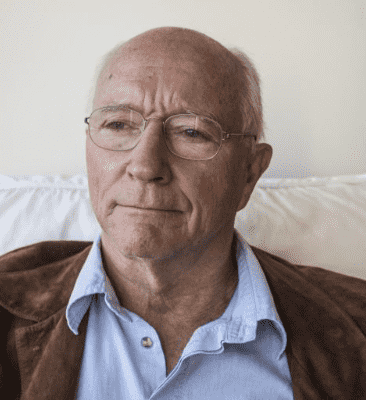
Lionel Snell
[1945〜 ]
official website:https://ramseydukes.co.uk/
Facebook:https://www.facebook.com/mousethatspins/
- Could you please give a brief self-introduction?
-
Better known by the pen name Ramsey Dukes.
I was born into a Kibbo Kift family and grew up a rather lonely child in deep Cotswold country. The 1950s was a time of Logical Positivism and high skepticism so that magic was very hard to find, but I did find it.
Trained as a pure mathematician, I noted similarities between magical and mathematical thinking. Wrote and published SSOTBME, an Essay on Magic in the mid 1970s, which has become recognised as a classic source for new magics such as the Chaos current. In 1977 I took the Abramelin retirement and in the 1980s I was initiated into OTO and IoT. I have recorded over 100 short talks on magic and related topics published on the Ramsey Dukes YouTube channel. - What are your hobbies?
-
Had to sell my motorcycle after a spine operation plus arthritis. Reading, gardening, delicious restaurants. Nature. Sunbathing. Gym.
- Why did you learn magic?
-
All children learn magical thinking as they learn to speak. It aligns with the discovery that awareness can exist outside their own heads, and so it connects all things. At around 5 years onward they are encouraged to learn NOT to think magically, but to believe in a world of isolated objects and events connected only by physical causality. So magic is not a thing you begin by learning, so much as discovering.
- What was the first magic you discovered?
-
Before 10 years old maybe Tove Jansen’s book “Finn Family Moomintroll” and the discovery of a beautiful alternative reality. Then came experiments in parapsychology: such as palmistry, dowsing, telepathy, trying to foresee lottery results.
At 10 I discovered The Book of the Sacred Magic of Abramelin the Mage, and then the works of William Butler, Dion Fortune etc. I first really got into Crowley when at University: Cambridge had a wonderful collection of books and correspondence with him. Around 1970 Gerald Yorke introduced me to the works of Austin Spare. These formed the foundation for my growing interest in magic. - Have you practiced witchcraft?
-
Around 5 years old I hated cricket, so I would pick Herb Robert to make it rain and cricket lessons would be cancelled. I tried a few other hedge-witch spells at that age. Later in life I did a lot of group rituals around Britain’s sacred sites with other witches. But never formally joined a coven.
- Can you share a successful story of your sigil magic?
-
Late 1970s and I was riding home from work on a brand new MotoGuzzi V-100 motorbike and I just shouted out at the top of my voice: “This is FREEDOM!” It was a glorious full-body experience of sheer joy.
Later I remembered that a couple of years earlier I had done a sigil to get money. To sharpen the intention I asked myself how much money to ask for and I decided “It is my will to have enough money to be free”. My work life was so awful at that time that I dreamed of enough money that I would not have to work again.
That year my brother inherited some money and decided he would repay £2,000 that I had once given him for deposit on a house. I reminded him the money was a gift, not a loan, but still he insisted on returning it. In those days £2k was enough to buy myself either an ordinary small car or a really exciting motorbike. I chose the latter and found I had bought a glorious sense of freedom.
Some people might argue this was a failed sigil magic, because I still had to work, but I have come to recognise it as a success in these terms: If I had actually won enough money not to need to work I would have removed a lot of challenge in my life, that might not have done me much good. Whereas the discovery of the joy of a big motorbike and all the unexplored roads of Britain taught me what REAL freedom feels like – an experience, not a condition.
It also taught me a lifelong lesson: my unconscious knew better what I REALLY needed, and it delivered it.NOTE: It was successful magic, but it happened in a way that broke not one single law of physics.
- What magic ideas are current in your world, and what is the ratio of Thelema, Golden Dawn, and Wicca?
-
As suggested in my contribution to This Is Chaos, I am very interested in the role of virtual reality in shaping our experience and protecting us from magic.
Thelema is probably top, then GD. I like Wicca, but I am no longer in touch with local Wiccans. - What magical tools do you use most often?
-
Not a lot now. Wand was my favourite, both as such and as a drumstick. I really like crystals but more for “energy” than direct scrying. I do use pendulum, tarot and I Ching yarrow stalks for divination. I was fascinated by CF Russel’s Holy Cube and made my own diminished version.
- Are there limits to learning magic through self-study?
-
I don’t believe in limits, but I do recognise obstructions such as boredom, lack of community sharing and the risk of delusion through isolation.
- Will the legalization of psychedelic drugs affect Chaos Magic in the future?
-
I’m sure it will, but don’t know how, or how much.
- Can you briefly explain why sigil magic works?
-
After the age 5 or so, we are taught not to believe in magic, but in a material world of solid objects. Our brains become programmed to build a virtual reality that excludes magic, a world where solid, unconnected objects obey only the laws of physics and probability. We have evolved this way because natural selection favours those who ignore or our unaware of the complexity of chaos – where everything is connected and meaningful. (Artists are the only people whose work allows them to keep a small window open to the underlying psychedelic truth – but we all know how hard most artists have to struggle to survive in a materialist culture.)
A sigil is an encrypted wish, boiled down so that the conscious mind cannot read it, but it can slip into the subconscious chaos of existence where supposedly “impossible” connections can happen. Tenuous links are found between money, freedom, motorcycles, joy etc and they can flow into a sequence that can happen without breaking any of the laws of physics: so they are permitted by the conscious brain’s censor. And they happen, as long as the magician is open to the magical result and does not let his brain say: “that was obviously just a coincidence”. - Is making children recite The Book of the Law child abuse, or is it a good thing?
-
I’m not keen on MAKING children read anything. I might even forbid TBOTL in order to pique their curiosity. There is more magic in discovering books than in being forced to read them.
- What do you think of untrained beginners using sigils to control lucid dreaming or astral projection?
-
I’ve not heard about that, so don’t have much to say.
But Josef Karika contributed a very interesting article in This Is Chaos about “Naïve Interventionism” in which he points out the error of trying to over-control natural processes. On the macro scale it has led to many environmental disasters. On the micro scale there have been so many cults based on the idea that the unconscious is a machine that can be perfected to make us into super humans – a recipe for craziness.
On the magical level it is the uncontrolled aspects of chaos that enable magic, because some slack in the causality chain is needed for magical results. - Peter Carroll says VR and AI destroy imagination, and money should be spent on real-world experience. What do you think?
-
I am really keen on real world experience, but do not think my imagination has been destroyed by VR or AI. I have been interested in AI since 1970, and it has stimulated a lot of my magical thinking (as in my article for This Is Chaos), but I do think that the potential for AI and VR is not being realised yet. Like most art forms, they need to get out of the hands of professionals and into the hands of amateurs to realise their potential. Matt Kabryn started some interesting work on remote avatar rituals when Oculus Rift was first launched.
- Peter Carroll says The Book of Pleasure is not a must-read, but recommends your books to the Japanese. Do the Japanese need to read it?
-
I was inspired by The Book of Pleasure but thought it was a tough read. That is why I wrote the article called Spare Parts to help people understand it.
I would love the Japanese to read my books as mine approach magic differently from Pete’s work, and he appreciated the difference between us. I would say that I especially admire Pete’s work on results magic – he was a science teacher as Ronald Hutton pointed out. But I was a pure mathematician and became more interested in magic as experience – the artistic rather than the scientific approach.
Results success is great, but it can lead towards a solipsistic world, whereas the joy of magic is also the beauty of surprise and meaningfulness. A journey of discovery and learning as much as of conquest.
Pete used to say that my books often begin with something banal and everyday – like “why do people talk to their cars” – and yet they take you from there into a world full of magic.
I feel that many books that begin with the extraordinary – other worlds, other powers, other dimensions – and leave you uncertain how to get there, while my books (Like How to See Fairies and The Little Book of Demons) begin with the ordinary and then lead you to discover the extraordinary that lies beyond. - Discordianism: Peter Carroll says long-term worship of Eris is dangerous and that Japanese Discordianism is wrong. What do you think?
-
In the 1970s I grokked the discordian vibe but never pursued it. (My reasons for not aligning with other currents are too personal for this short interview). So I really do not know enough about the state of the art now – let alone in Japan – to comment.
- Could you please give a word of advice to Japanese magicians?
-
Read my books (or watch my YouTube videos) as well as Pete’s and dance in the space that lies between them.
- Have you ever been to Japan, or would you like to visit? Also, do you have any favorite Japanese foods?
-
Never had a chance to go to Japan, and am now too old and handicapped to make the journey
At age 12 I was so fascinated with Japanese architecture and style that I decorated my school study with kakemono scrolls and I made a Japanese style lamp shade and a bamboo and twine wall-piece based on the golden ratio.
Every Monday my wife and I go for lunch at the nearby Cape Point Vineyard where they offer a short menu of delicious sushi.
Directory of Modern Magicians > Lionel Snell